
Last Updated: May 2026
Gutters are not an afterthought. They are part of your roof system. When they fail in New Orleans, the cascade of damage hits your fascia, soffit, foundation, and landscaping in the same rainstorm. And they will fail if you treat them the way homeowners in drier cities do, with one cleaning per year and the assumption that everything is fine. New Orleans is not a one-cleaning-per-year city. The volume of water, the type of debris, and the speed at which biological growth colonizes standing water make gutter maintenance a year-round responsibility for every homeowner from Lakeview to the West Bank. Big Easy Roofing evaluates gutter condition during every roof inspection across the metro area.

Three factors combine to make New Orleans one of the hardest cities on residential gutters in the United States.
First, volume. The city averages over 64 inches of rainfall per year and sees thunderstorm activity on 80+ days annually. A single afternoon storm can dump 2 to 3 inches in under an hour. Standard 5-inch K-style gutters handle approximately 5,000 square feet of roof area in moderate rainfall. During a New Orleans downpour, those same gutters are over capacity within minutes if any debris restriction exists.
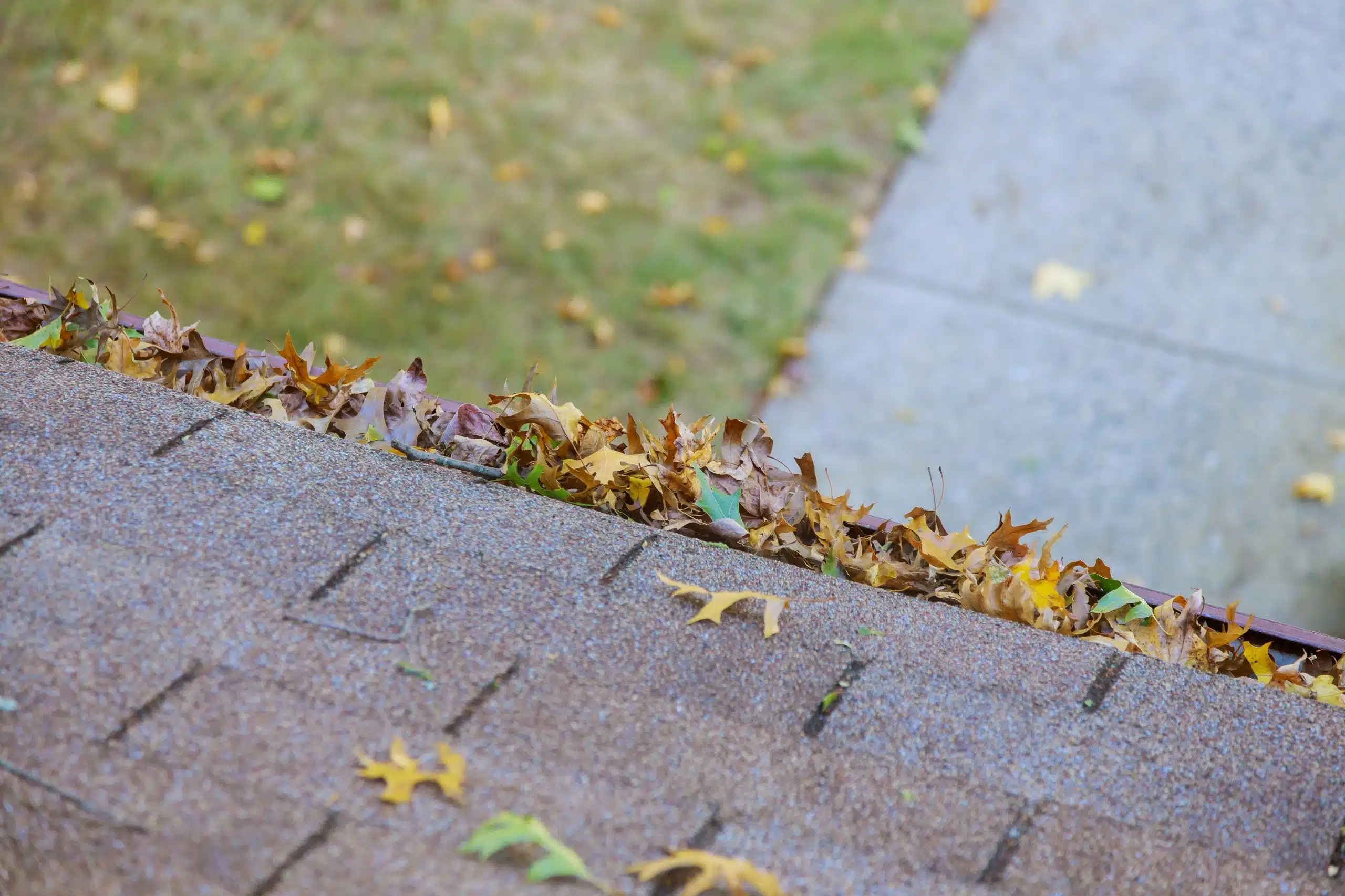
Second, debris type. New Orleans neighborhoods like the Garden District, Uptown, Mid-City, and Gentilly have dense live oak canopy. Live oaks shed leaves gradually year-round rather than dropping all at once in fall. Spanish moss, a signature feature of the city’s tree canopy, falls in clumps that mat together in gutters and block flow more aggressively than dry deciduous leaves. Pine needles from loblolly pines weave into a mesh that water cannot penetrate.
Third, biological growth. Standing water in a partially clogged gutter becomes a growth medium for algae, mosquito larvae, and mold within days in New Orleans humidity. This growth adds weight, further restricts flow, and creates health and pest issues beyond the structural damage to the gutter system.
Each debris type behaves differently and requires different attention.
Live oak leaves: Small, curved, and waxy. They shed year-round with heavier drops in spring (March through May). They curl as they dry and interlock when wet, forming dense mats at gutter joints and downspout openings. Unlike maple or elm leaves that decompose quickly, live oak leaves resist breakdown and accumulate over multiple seasons if not removed.
Spanish moss: Falls in long, fibrous strands that wrap around gutter hangers, downspout strainers, and anything protruding into the gutter channel. Wet Spanish moss absorbs water and becomes heavy, pulling gutters away from the fascia. It also traps smaller debris particles against it, building a compounding blockage.
Pine needles: Thread through gutter screens and weave together into a water-resistant mat. Standard gutter guards with slots or perforations do not stop pine needles from entering the gutter. Once inside, they are harder to flush than leaves because they do not break apart under water pressure.
Roofing granules: Asphalt shingles shed granules throughout their life, and the rate increases as shingles age. Granules settle to the bottom of the gutter and accumulate as a gritty sediment that slows water flow and adds weight. Heavy granule buildup in the gutter also signals that your roof’s shingles are nearing the end of their service life.
Three to four times per year is the baseline for most New Orleans homes. Properties under heavy tree canopy, particularly the Garden District, Uptown, parts of Carrollton, and older sections of Metairie, may need cleaning every 6 to 8 weeks during peak debris seasons.
A practical schedule for most New Orleans homeowners:
After every named storm or heavy rainfall event (2+ inches in one hour), check gutters from the ground for visible overflow marks, sagging sections, or debris pileup at the downspout entry points. You do not need to climb a ladder for this check. Water stains on the fascia below the gutter line, soil erosion directly below overflow points, and puddles against the foundation all indicate overflow occurred.

Overflowing gutters do not just make a mess in your flower beds. They cause structural damage that compounds with every rain event.
Fascia board rot: Water spilling over the back edge of the gutter runs directly onto the fascia board. In New Orleans humidity, wet wood does not dry between rain events. Within one season of consistent overflow, the fascia softens and begins to rot. Replacing fascia requires removing the gutters, cutting out the damaged sections, and installing new lumber before reattaching the gutter system. Cost: $15 to $25 per linear foot including labor.
Soffit damage: Once water reaches the fascia, it migrates into the soffit panel behind the gutter. Damaged soffit allows water into the rafter tails and the edge of the roof deck. It also creates entry points for pests, including squirrels, birds, and wasps that exploit the soft or missing material to access the attic space.
Foundation erosion: Water dumping over the gutter edge instead of flowing through downspouts concentrates at the foundation wall. In New Orleans, where soil conditions already create foundation challenges, concentrated water runoff accelerates soil displacement and can contribute to uneven settling.
Roof edge damage: Water backing up behind a clogged gutter can wick under the lowest row of shingles through capillary action, saturating the starter strip and the edge of the roof deck. This is a common source of mysterious attic leaks that appear unrelated to the gutter system.
Please note: The prices in this article are estimates only, shared to help you plan. Your actual cost depends on your property, the materials and the size of the job. For pricing on your project, call Big Easy Roofing at (504) 800-8196 for a quote.
Some do. Most do not perform as advertised in this specific debris environment. The honest answer depends on the type of guard and the type of trees surrounding your home.
Micro-mesh guards are the most effective option for New Orleans. They block fine debris including pine needles while allowing water to flow through the mesh surface. They handle live oak leaves well because the leaves sit on top and dry in the sun, then blow off or are easily brushed away. They are the most expensive option, running $15 to $30 per linear foot installed.
Perforated metal or screen guards stop large leaves but allow pine needles and small Spanish moss fragments through. They need cleaning almost as often as open gutters in neighborhoods with pine trees. They also accumulate debris on top that blocks water from entering during heavy rain.
Foam or brush inserts fill the gutter channel and allow water to flow through while blocking debris. In New Orleans, these collect sediment and organic matter inside the foam, creating a decomposing mat that is harder to clean than an open gutter. They also support algae and biological growth in the humid climate. Not recommended for New Orleans installations.
No gutter guard eliminates the need for maintenance. Guards reduce the frequency and make cleaning easier, but they must still be checked and cleared. Any guard product that claims zero maintenance in a New Orleans environment is overpromising.
These signs indicate gutter problems that need attention before the next major rain:
If you notice fascia softness when you press on it near the gutter attachment points, the wood has already begun to rot. This is not a gutter-cleaning issue at that point. It is a fascia replacement and soffit and fascia repair project that should happen before any gutter reattachment.
Professional gutter cleaning for a single-story New Orleans home runs $100 to $200. Two-story homes cost $150 to $300. Prices increase for heavily clogged systems, homes with extensive tree coverage, or gutters that require minor repairs during the cleaning visit.
Yes. Water backing up behind a clogged gutter can wick under shingles at the roof edge through capillary action, saturating the starter strip and deck edge. This creates leaks that appear in the attic near the eaves and are often misdiagnosed as a shingle problem when the gutter is the actual cause.
If your gutters are over 15 years old, showing corrosion, or have persistent sagging issues, replacing them during a reroofing project saves labor cost because the gutters come off for the roof installation anyway. New seamless aluminum gutters cost $6 to $12 per linear foot installed.
For most New Orleans homes, yes. Six-inch K-style gutters handle approximately 40% more water volume than standard 5-inch gutters. Given the intensity of local rainfall, the upgrade provides meaningful overflow protection during heavy storms for a modest cost increase of $1 to $3 per linear foot.
Not necessarily. Regular cleaning is effective and costs less than guard installation. Guards make sense if you want to reduce cleaning frequency, have difficulty scheduling reliable cleaning service, or have gutters that clog between scheduled cleanings due to heavy tree debris.
Single-story homes with stable, level ground for ladder placement can be cleaned by homeowners with basic ladder safety knowledge. Two-story homes present fall risks that make professional cleaning the safer choice. Never lean a ladder against the gutter itself, and never work on gutters during or immediately after rain when surfaces are slippery.
Seamless aluminum gutters last 20 to 30 years with proper maintenance. Galvanized steel gutters last 15 to 20 years before corrosion becomes a problem. Copper gutters last 50+ years but cost significantly more upfront. In New Orleans, the humidity and salt air from Lake Pontchartrain accelerate corrosion on steel gutters compared to inland installations.
Algae and moss affect asphalt shingles differently, and the distinction matt...
Read More
Are you a homeowner in New Orleans area looking for reliable roofing contract...
Read More We've all heard it: "Roof tiles reduce heat and help keep your house cooler"....
Read More Commercial flat roofs in Louisiana should be professionally inspected at lea...
Read More Summary: Siding installation mistakes that might go unnoticed in drier clim...
Read More Installing a flat roof is an important and expensive process that requires kn...
Read More 



 By Big Easy Roofing
  Jun 10, 2026