

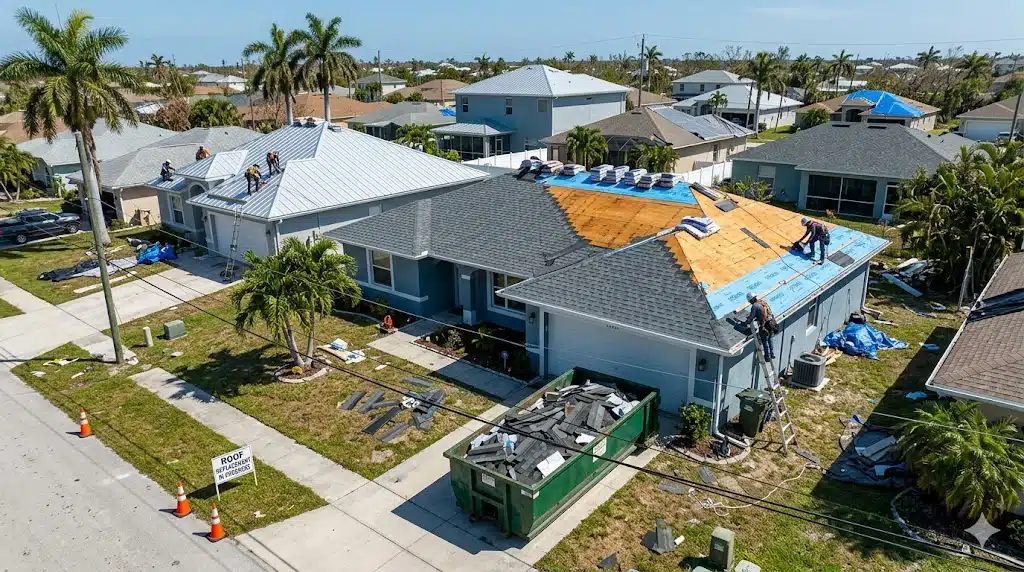
A pre-season schedule a roof inspection is your first and most cost-effective line of defense before June 1. Trained inspectors from Big Easy Roofing evaluate every component that bears the brunt of hurricane-force winds, from field shingles to edge details, looking for anything that could fail under sustained pressure or driving rain.

Lee, Charlotte, and Collier Counties fall within Florida’s High-Velocity Hurricane Zone (HVHZ) equivalent standards, meaning roofing systems face stricter requirements than most of the country. Any permitted roofing work completed through Big Easy Roofing’s Florida services is performed to code, with inspection sign-off from the applicable county building department.
Not all roofing materials perform equally under hurricane conditions. Southwest Florida homeowners should weigh wind resistance ratings, long-term durability, and insurance implications when choosing between asphalt, metal, and tile systems. Big Easy Roofing installs and services all three material types and recommends the following based on performance data from Gulf Coast storm seasons.
Class 4 impact-rated shingles carry an FM 4473 or UL 2218 certification and are tested against simulated hail and high-wind conditions. In Southwest Florida, manufacturers such as GAF and Owens Corning offer shingles rated for 130 mph or higher when installed with ring-shank nails and a proper secondary water barrier. Class 4 shingles qualify for insurance discounts with most Florida carriers and represent the most affordable path to code compliance for existing homes.
Standing seam and screw-down metal panels outperform asphalt in sustained wind events because interlocking seams eliminate exposed fasteners that can pull loose under uplift pressure. Well-installed upgrade to metal roofing systems routinely exceed 160 mph wind ratings and can last 40 to 70 years in coastal climates with minimal maintenance. Metal is the preferred upgrade for homeowners who want one installation that lasts multiple decades and provides the strongest protection available.
Tile roofing is common across Southwest Florida and resists UV degradation and salt air corrosion better than asphalt. However, tile requires correct fastening and a fully waterproof underlayment beneath because individual tiles can crack or dislodge in Category 3 or higher winds. Underlayment integrity is critical: if tile lifts, the secondary water barrier is the last line of defense against interior water damage.
Regardless of the primary roofing material, a synthetic secondary water barrier is one of the highest-value upgrades available to Fort Myers homeowners. If shingles or tiles are compromised during a storm, the underlayment prevents water from reaching the sheathing and interior. Florida Building Code requires secondary water barriers on new construction and major re-roofing projects, and they qualify for My Safe Florida Home grant funding as a standalone upgrade.
The My Safe Florida Home (MSFH) program is a state-funded initiative administered by the Florida Department of Financial Services. It provides free wind mitigation inspections and matching grants to eligible Florida homeowners who complete qualifying wind-resistance upgrades. For homeowners in Lee, Charlotte, and Collier Counties, the program can offset a significant portion of the cost of roof improvements before the 2026 hurricane season.
Eligible applicants receive a state-funded inspection at no cost. The inspector evaluates roof shape, roof deck attachment, roof-to-wall connections, opening protections, and the presence of a secondary water barrier. The inspection report is used both to qualify the home for grant funding and to submit to your insurance carrier for a premium reduction.
My Safe Florida Home offers matching grants of up to $10,000 for qualifying upgrades, with the state covering 2 dollars for every 1 dollar the homeowner contributes. Eligible improvements include roof deck attachment upgrades, secondary water barrier installation, opening protection (impact windows, doors, and garage doors), and roof covering replacement with code-compliant materials. Grants are subject to program funding availability and require a signed contract with a licensed contractor before construction begins.
Income-qualified homeowners (at or below 80 percent of the Area Median Income) may qualify for grants of up to $10,000 with no matching requirement. This provision prioritizes homeowners who face the greatest financial barrier to making wind mitigation improvements before hurricane season.
Applications are submitted through the My Safe Florida Home portal at mysafefloridahome.com. Homeowners must hold a homestead exemption on the property, carry a current property insurance policy, and have a home with an insured value of $700,000 or less. Big Easy Roofing can coordinate the inspection and contractor documentation required to complete an application.
A wind mitigation inspection and the resulting report are among the most financially valuable documents a Southwest Florida homeowner can obtain. Insurance carriers use the report to calculate credits against your annual premium based on structural features that reduce the likelihood and severity of wind damage claims. In Florida, the Office of Insurance Regulation requires carriers to offer these credits to policyholders who submit a qualifying wind mitigation report.
A licensed wind mitigation inspector evaluates seven attributes defined under Florida’s Uniform Mitigation Verification Inspection Form (OIR-B1-1802): year the roof covering was installed, roof deck attachment method, roof-to-wall connection type, roof shape (hip vs. gable), secondary water resistance, and opening protection. Each attribute is scored independently, and credits stack based on the combination of features present.
Hip roofs, which slope on all four sides, qualify for the largest single credit because they resist wind uplift better than gable roofs. Secondary water barriers, impact-rated shingles or metal roofing, and hurricane straps or clips at the roof-to-wall connection each add additional credits. Homeowners who complete multiple upgrades simultaneously often see combined savings of 10 to 30 percent on their annual premium with Citizens Property Insurance or a private carrier.
Once Big Easy Roofing completes permitted work and the county inspection passes, request a wind mitigation inspection from a licensed inspector. Submit the completed OIR-B1-1802 form directly to your contact your insurance agent. Carriers are required by Florida law to apply the applicable credits at your next renewal or mid-term if the policy allows mid-term endorsements. Savings often exceed $500 annually on policies with Citizens Property Insurance.
Timing is as important as the work itself when it comes to hurricane preparation. A roof replacement that begins in late May or early June risks permit delays, material backorders, and incomplete work when the season’s first named storm forms. Big Easy Roofing recommends scheduling replacements between February and April to ensure every step finishes with time to spare before June 1.
Lee County, Charlotte County, and Collier County each require building permits for re-roofing projects above minor repair thresholds. Permit processing typically takes 5 to 15 business days depending on the workload of the local building department. Submitting permit applications in February or March avoids the spring surge when every contractor in Southwest Florida is competing for the same permit slots before storm season opens.
Impact-rated shingles, synthetic underlayment, and metal roofing panels are in high demand across Florida’s Gulf Coast ahead of each hurricane season. Material lead times that run 2 to 3 days in January can stretch to 1 to 2 weeks by May, especially following high-demand events like early storm forecasts or insurance carrier incentive deadlines. Locking in materials early protects your timeline and your access to preferred products.
My Safe Florida Home grant funding is disbursed on a first-come, first-served basis and frequently runs out before mid-year. Homeowners who apply in January or February are more likely to receive funding and complete qualifying work before the June 1 deadline than those who apply in April or May. Scheduling your Fort Myers roof project early also allows time to address any permit corrections or material substitutions without disrupting the completion date.
Once payment is received, Big Easy Roofing backs every replacement with a 24-hour roof replacement guarantee. Call (504) 800-8196 to lock in your April or May installation date before the spring schedule fills.
Even a well-maintained, recently replaced roof can sustain damage from a direct storm strike. Having a documented plan and a trusted contractor already in your contacts reduces stress, speeds up insurance claims, and gets your home stabilized faster when it matters most.
Trim or remove tree limbs within 10 feet of your roofline. Clear gutters and downspouts completely so water drains freely during peak rainfall. Photograph your roof from multiple angles using your phone and save the images with a date stamp: these before photos are critical if you need to file an insurance claim after the storm. Store your policy number, claims hotline, and Big Easy Roofing’s emergency number, (504) 800-8196, in your phone contacts before a storm watch is issued.
Do not walk on a damaged roof. Water-logged decking can collapse under foot traffic, and damaged areas may not support weight. Inspect from the ground or from an attic access point. Document all visible damage with photos and video before any repairs begin. Contact Big Easy Roofing’s call for emergency roofing team as early as possible: emergency tarping is available 24 hours a day and stabilizes the home while you coordinate with your insurance adjuster.
Request a copy of the adjuster’s estimate and scope of loss before signing any contractor authorization. Big Easy Roofing works directly with insurance carriers to ensure the scope of get repairs done fast matches the actual damage documented on-site. If the estimate is lower than the cost of a code-compliant repair, a licensed public adjuster or your contractor’s supplemental documentation can support a revised claim. Keep all receipts, contractor invoices, and communication records throughout the claims process.
Big Easy Roofing was founded and trained on Louisiana’s Gulf Coast, one of the most demanding environments for roofing contractors in North America. Louisiana’s exposure to major hurricanes, high humidity, extreme summer heat, and salt-air coastal conditions mirrors the conditions Southwest Florida homeowners face each year. That regional background directly informs the standards, materials, and installation practices the team applies on every Fort Myers roofing project.
The team has worked through the aftermath of Gulf Coast hurricanes that tested every assumption about roofing system performance: which fastening patterns hold, which underlayments fail at the seam, where water finds its way through flashing that looked watertight before the storm. That firsthand experience is not available in a manufacturer training manual. It informs decisions about fastener placement, overlap dimensions, and penetration sealing that most contractors only learn after a claim comes back.
Louisiana’s coastal parishes operate under roofing standards comparable to Florida’s High-Velocity Hurricane Zone requirements. Big Easy Roofing’s crews are accustomed to working within these specifications as a baseline, not as an upgrade. When the same standards apply in Lee County or Collier County, the team applies them as a matter of routine, not as a new learning curve.
Gulf Coast humidity, afternoon thunderstorm cycles, and prolonged summer heat create moisture management challenges that differ significantly from roofing in dry or northern climates. Big Easy Roofing selects underlayments, flashing materials, and sealants that maintain adhesion and flexibility across Southwest Florida’s full temperature range, from winter lows in the 50s to summer highs above 95 degrees. That material familiarity reduces callbacks and extends system life between replacements.
The Atlantic hurricane season runs from June 1 through November 30 each year. NOAA and the National Hurricane Center issue official forecasts in May and update outlooks throughout the season.
At minimum twice yearly: before hurricane season (April or May) and after any major storm. If your roof is over 15 years old, inspect it annually or consider a professional assessment.
If roof work exceeds 25 percent of the total roof area, the entire roof must be upgraded to meet current Florida Building Code standards, including impact-rated shingles, secondary water barriers, and proper fastening.
No. My Safe Florida Home grants fund new improvements to existing roofs, not prior work. However, other soffit, fascia, and flashing upgrades may still qualify if not previously funded.
Metal roofing is inherently more wind-resistant than asphalt shingles. However, flashing, fasteners, and penetration seals remain critical regardless of material. Big Easy Roofing ensures all metal systems meet code for high wind zones.
Most residential replacements complete in 3 to 5 days depending on roof size, weather, and complexity. Big Easy Roofing schedules jobs in April or May to ensure completion well before June 1.
Emergency tarping (available 24 hours) stabilizes the home and protects contents. Work with Big Easy Roofing to document damage for insurance, then schedule repairs once your claim is approved.
Yes. Citizens Property Insurance and private carriers offer 5 to 15 percent discounts on policies when wind mitigation improvements (including new roofs) are documented and verified. Savings often exceed $500 annually.
Ready to fortify your Fort Myers roof before the 2026 hurricane season? Call Big Easy Roofing at (504) 800-8196 to schedule a free inspection or get a quote. The team handles everything from emergency tarping to full replacements, and every roofing project comes backed by a 24-hour roof replacement guarantee once payment is received.
For more information about hurricane-ready roofing, visit Big Easy Roofing or review our Fort Myers page. Explore options including professional roof inspections, metal roofing, and emergency roofing.
Living beneath a roof is one of the basic needs of every household, but have ...
Read More
New Orleans homeowners deal with more roof wear than most of the country. Bet...
Read More Why does temperature matter so much when installing shingles? It directly aff...
Read More How to prevent gutters from clogging? Keep your gutters clean - This is an ob...
Read More As an environmentalist, you understand the importance of protecting the plane...
Read More Replacing a roof is an important home improvement project that requires caref...
Read More 



 By Big Easy Roofing
  Apr 15, 2026


